What is the Upper Lusatian house?
The Upper Lusatian house vs. a log house
Upper Lusatian Houses feature a type of wooden structure used in the construction of log houses. Log houses are built from wooden beams laid lengthwise on top of one another, with the joints between the beams filled with white caulking typically made from clay and chopped chaff. At the corners, the beams were joined using various carpentry joints, which varied from region to region and from carpenter to carpenter. The difference between a log cabin and a log house is obvious at first glance – log houses are built from planed logs that overlap at the corners with no caulking between the joints. Basically, they could be described as a simple log cabins.
So how can one know a house is built in the Upper Lusatian style?
The Upper Lusatian houses are very easy to spot – a wooden frame of vertical timber posts, joined into an arch above the windows, stands in front of the log walls. Other distinctive features include divided windows, usually with six or four panes, variously decorated or arranged gable cladding, a stone foundation, and, in the past, a slate roof. Although some of these houses were built as single-story structures, two-story buildings are more common – with a timber-framed or half-timbered upper floor, sometimes featuring a gallery depending on which part of northern Bohemia the particular house was built.
Why did they use to build them like this?
In a standard log house, the timber walls tend to “settle” over time – not only do they sink, but the roof or upper floor can also become deformed. The purpose of the Upper Lusatian style of building is to relieve the weight of the roof and upper floors from the structure of the house, the load being distributed evenly around it. This prevents the log walls from spreading apart and also makes it somewhat easier to replace any damaged beams.
The Upper Lusatian house over the years
A brief overview of the history of the traditional house in the Tripoint region
The first log cabins appeared in the Czech lands during the Middle Ages, brought by settlers from the German side of the border around the 13th century. Over the centuries, these simple log cabins evolved into their present form, one that was well-suited and well-adapted to the demands of the local climate. Frequent rain showers, an alpine climate in some areas, barren soil, and forested valleys crisscrossed by rivers inevitably led to the development of trade and craftsmanship. The region’s abundant timber resources were the primary focus. Wooden channels were built in the forests to float logs down to the rivers from where they were transported on rafts throughout the country. Traces of this logging activity can still be found in the local forests today. From there, innovations in log cabin construction were a logical step.
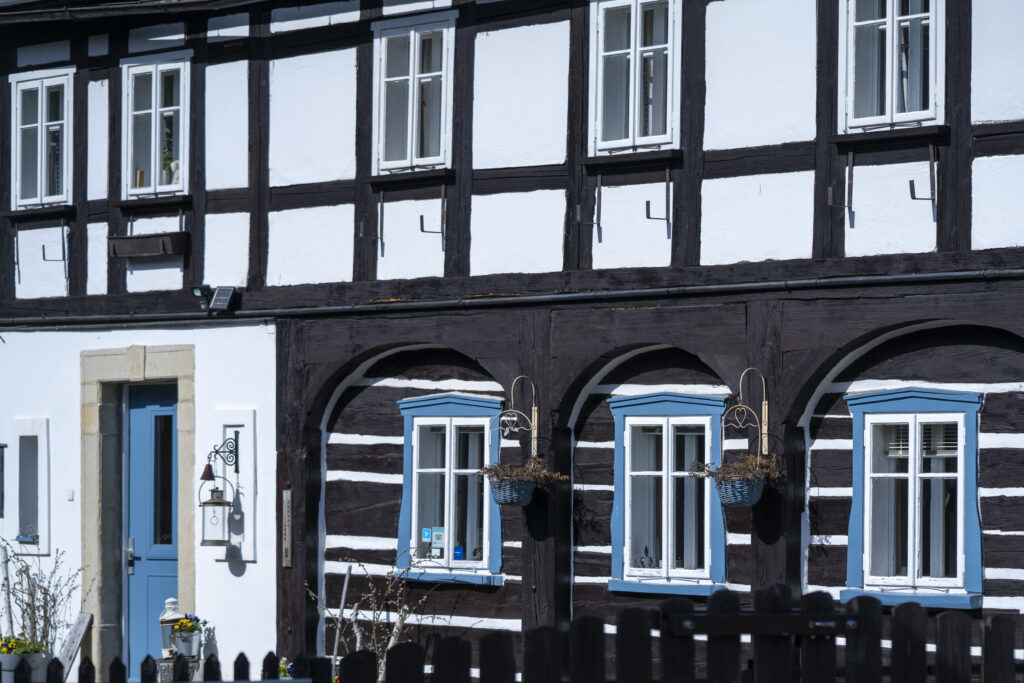
It was between the 17th and 18th centuries that Upper Lusatian houses experienced their greatest boom in several directions. Interestingly, within the small region of the Lusatian Mountains and the Tripoint area, we find two types of these structures: the Upper Lusatian one – largely inspired by German architecture and thus featuring a half-timbered upper story – and the North Bohemian one, featuring a log-built upper story. A beautiful example of houses with half-timbered upper stories can be found, for instance, in the historic village district of Kryštofovo Údolí; log-cabin houses are more common on the other side, e.g. in Sloup v Čechách or in Krompach.
No two houses are alike
It is also worth noting that each house is unique. This is no small feat, given that there are currently about 19,000 standing Upper Lusatian-style houses in Bohemia, Poland, and Germany – though unfortunately, not all of them are habitable. In addition to the diversity in the style of the upper story, they also differ in terms of woodcarving, mainly when it comes to the lower stories and wings. Owners or builders could also express their individuality in the construction of the gable, cladding it with simple wooden boarding or creating intricate mosaics from broken slate. Just as these houses were once inhabited by residents of all economic backgrounds, today they are scattered across the landscape like hidden pearls. An Upper Lusatian house may stand alone near a forest, in the centre of town, or among other buildings in the same style. Their uses were varied, ranging from simple dwellings to glassblowing or weaving workshops. Even today, these half-timbered structures receive the recognition they deserve – they house tourist information centres, headquarters of multinational companies, serve as cottages, restaurants, or guesthouses.

Come experience their magic for yourself
On May 30, 2026, an event called the Upper Lusatian House Open Day will take place in the regions of the Šluknov Hook, the Lusatian Mountains, and the Frýdlant area. Private owners will open the doors of their homes to the public to share the history, trials, and joys of caring for their traditional buildings. You can find more information here and on our Facebook page – The Lusatian and Zittau Mountains – The Undiscovered Gem of the North. If you are interested how these houses look in neighbouring countries, they will be open to the public on May 31 in Germany and Poland.